
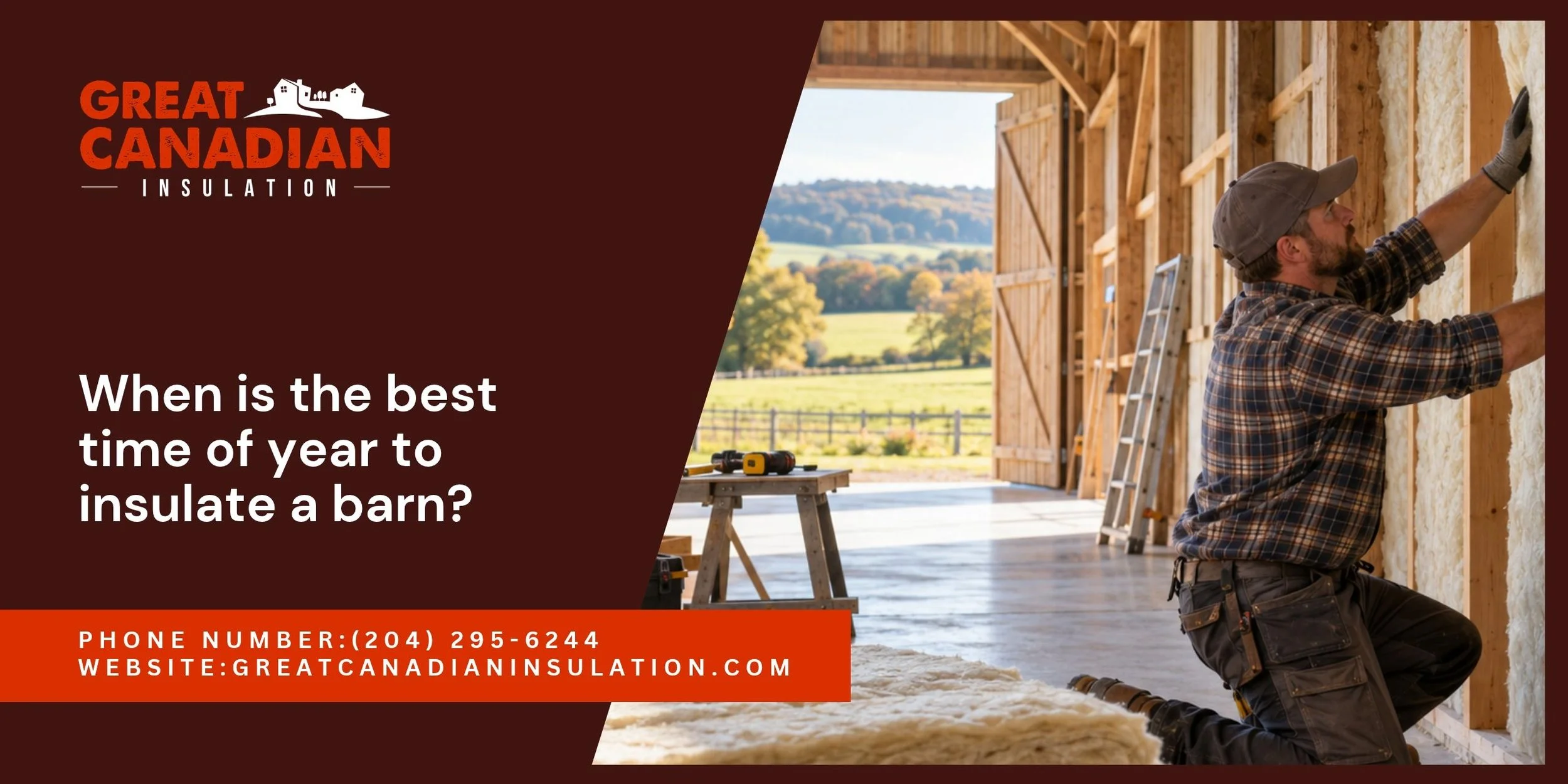
If you've been putting off insulating your barn, it's likely because you don't know when to start. When the brisk Manitoba winter rolls around, condensation ends up on the walls and heat disappears through the roof.
Insulating a barn doesn't have to be done at a specific time. While some times of year are better than others in Winnipeg and rural Manitoba, the right timing depends on how your buildings are used. At Great Canadian Insulation, we've been insulating agricultural buildings across Manitoba for over 40 years, so that's why we're here to give you advice about timing.
Is There a Best Time of Year to Insulate a Barn?
Insulating your barn before you need it most matters. In Manitoba, that's getting the work done ahead of the coldest months so your building is ready when temperatures drop, condensation starts forming and heating costs start to climb. Don't wait until the middle of a deep freeze. Otherwise, you will need to live with the problem until you find a solution.
The right timing is based on how you use your barn. A building that sits mostly empty in the summer will have a different window than one that's busy year-round.
Why is Fall a Smart Time to Insulate Your Barn?
In Manitoba, fall is often the right time. With the harvest wrapping up, buildings tend to be between seasonal uses and winter is just around the corner, so the benefits are almost immediate. By insulating in the fall, you get your barn ready for the coldest months so it holds heat better and is less likely to have condensation form on cold metal surfaces.
It also prevents surprises later. If you book an assessment and it determines something needs attention before insulation goes in, you won't be racing against the clock.
Can You Insulate a Barn in Winter?
While possible, it's not the most convenient option. Winter conditions are harsh. Plus, scheduling can be difficult, and the building's condition, temperature and how it's being used all make a difference. If your barn is having issues already and you can't wait until spring, consider speaking to a professional to determine what's realistic for your building. Having a team that understands Manitoba conditions will get you an honest answer on whether winter installation makes sense or if it's better to plan around it.
While possible, it’s not the most convenient option. Winter conditions are harsh. Plus, scheduling can be difficult, and the building’s condition, temperature and how it’s being used all make a difference. If your barn is having issues already and you can’t wait until spring, consider speaking to a professional to determine what’s realistic for your building. Having a team that understands Manitoba conditions will get you an honest answer on whether winter installation makes sense or if it’s better to plan around it.
What About Spring and Summer?
Spring and summer are other options, especially if your barn is empty or lightly used. When winter is over, there isn't as much pressure to insulate right away and there's more flexibility to schedule around your operation. It's a great way to get ahead of next winter instead of reacting to it. Closed-cell spray foam insulation installed in the off-season is ready to go when the first hard frost rolls around.
What Else Should You Consider When Timing Your Barn Insulation?
Seasons matter, but the way your operation runs does too. Consider the following:
How the Building is Used: Livestock barns, equipment storage and farm shops have different downtimes. Timing the work around when the building gets the least use will make the process much smoother.
Planned Projects and Busy Periods: Calving, seeding and harvest demand more from your time and your buildings. Scheduling around them prevents insulation from competing with the rest of your workload.
The Condition of the Building: Existing moisture problems, rust or damage can directly impact what needs to happen first. It also helps to have the building assessed sooner rather than later.
Lead Time: Planning ahead offers additional flexibility compared to waiting until the problem is urgent.
The same principle applies whether you're insulating a pole barn, a Quonset or a traditional livestock barn.
Planning Ahead to Insulate Your Barn?
Start insulating your barn at the time that works best for your building and your operation. Starting your planning early provides more options. When you choose Great Canadian Insulation, our team will honestly assess your barn, discuss the timing that makes sense and install closed-cell spray foam to the highest standard without the upselling.
Getting ready to insulate your barn before winter? Contact us for a free estimate today.